


When you choose products for Shopify dropshipping, the product decides most of what comes after: your ad cost, your delivery time, your returns and your reviews. A good store design cannot save a product with no margin or a 3-week delivery time. A plain store with the right product can still sell.
I set up dropshipping stores for clients with  DSers and
 CJdropshipping, and I check products with the same method every time. This guide shows that method step by step, with real fees, a scorecard you can copy, and where to look for ideas on
 AliExpress,
 Zendrop,
 Google Trends,
 TikTok and
 Amazon. I checked every fee and tool detail below against official pages in November 2026.
Here is what you will learn:
- How to choose products for dropshipping in 6 clear steps
- How to do the margin math with product cost, shipping, fees and ads
- What to check on a supplier listing before you import it
- Where to find ideas, and which sources only show demand
- Which products to avoid, and how to test one with a sample order
How to choose products for dropshipping: the short answer
Pick a product that solves a problem or serves a hobby, sells in a price band that can pay for ads, still leaves profit after every cost, and ships from a supplier you have checked. Then score it, order a sample, and only run ads if it passes.
The six steps below turn this into a routine you can repeat.
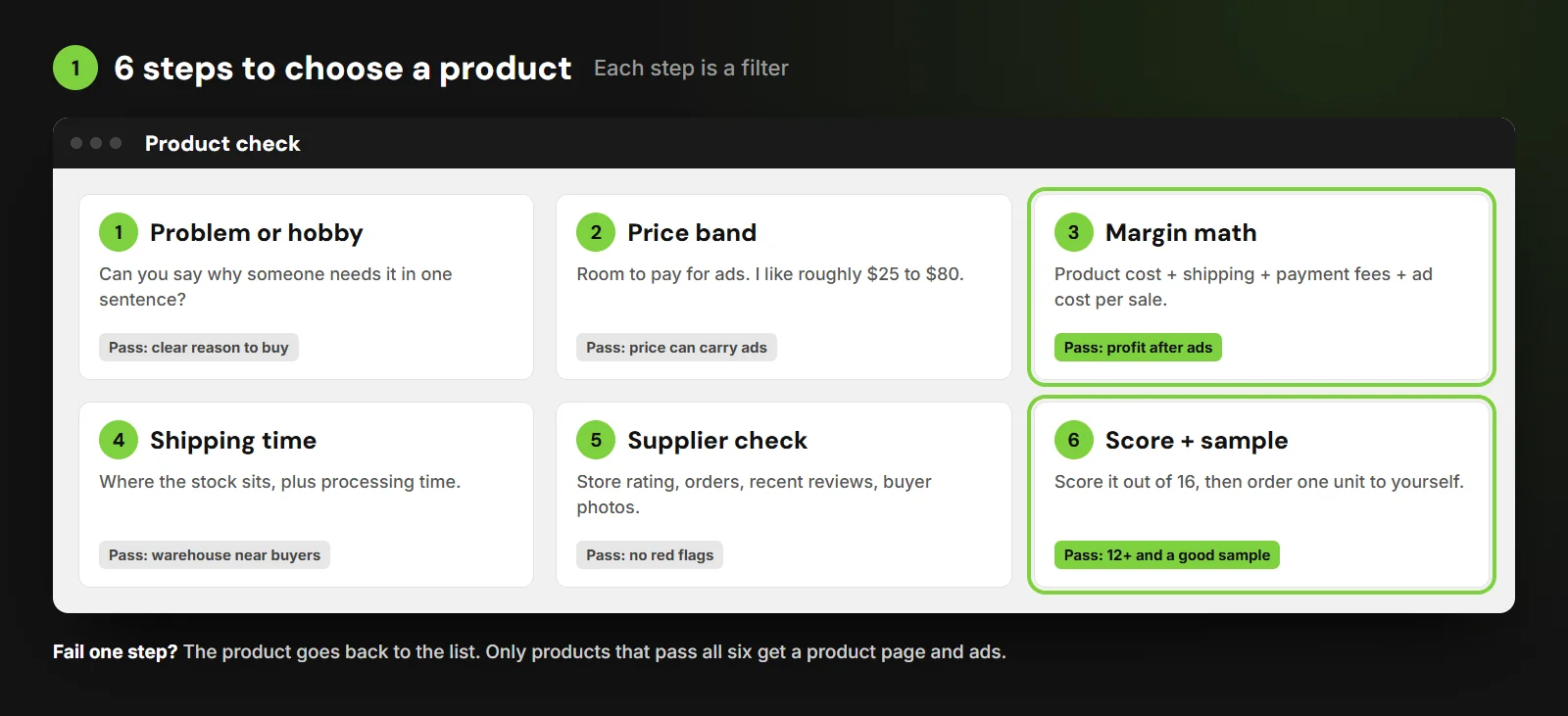
Step by step: choose products for Shopify dropshipping
This is how to choose products for dropshipping without guessing. Work through the steps in order. Each one is a filter, so weak ideas drop out early.
Step 1: Start with a problem or a hobby
Products sell best when the buyer can see the reason to buy in a few seconds. A problem product fixes something annoying, like pet hair on a sofa or a messy cable drawer. A hobby product serves people who already spend money on a passion, like fishing, baking or gaming.
Ask one question: can I explain why someone needs this in one sentence? If you need a paragraph, the ad will struggle too. Shopify’s own guide on choosing products to sell also suggests building around a theme, an audience or a need, so the products fit together.
Step 2: Pick a price band that can pay for ads
Very cheap products rarely work with paid ads. If an item sells for $12, there is almost nothing left to pay for a customer. Very expensive products need more trust, faster delivery and better support than a new store can give.
On client stores, I like items that sell for roughly $25 to $80. That is my rule of thumb, not a law.
Step 3: Do the margin math before you import
Add up every cost for one order before you import anything. You need four numbers:
- Product cost: the price the supplier charges you.
- Shipping: what the supplier charges to ship one unit to your buyer’s country.
- Payment fees: on Shopify’s Basic plan in the US, card rates start at 2.9% + 30¢ (shopify.com/pricing, checked November 2026). Your rate depends on your plan and country.
- Ad cost per sale: what you expect to spend on ads to get one order.
Here is an example with made-up numbers. You sell at $34.99. The product costs $8.50 and shipping costs $4.50. The card fee is about $1.31. That leaves $20.68 before ads. So you can spend up to $20.68 on ads per sale and still break even. If ads cost $15 per sale, you keep about $5.68.

Your Shopify plan and apps add a monthly cost too. See my breakdown of what a Shopify store costs per month. My dropshipping profit margin calculator does this math for you and shows your break-even ad cost.
Step 4: Check shipping time and warehouse location
The same product can arrive in 5 days or in 3 weeks. It depends on where the stock sits. Before you list anything, check where it ships from and how long the supplier says it takes to reach your buyers.
Look for stock in a warehouse near your main market, like a US warehouse for US buyers. Then add processing time on top. My guide to dropshipping shipping times lists what each supplier states.
Step 5: Check the supplier and the listing
A good product from a weak supplier still causes refunds. This is the part of dropshipping product research that people often rush. Open the listing and check these five things:
- Store rating: a seller with a long history and a high rating.
- Orders: the item has sold before, not just been listed.
- Reviews: recent reviews that talk about quality and delivery, not only “fast shipping”.
- Buyer photos: real photos that match the product photos.
- Ships from: a warehouse option close to your buyers.
Read the 1-star and 2-star reviews first. They show you the problem you will get emails about.

Step 6: Score it, then order a sample
The last step to choose products for Shopify dropshipping is a score. Use the table further down. If it scores well, order one unit to your own address before you spend on ads. The sample tells you more than any listing can.
Where to find products to dropship
Dropshipping product research starts with two kinds of places. Supplier catalogs are where you can actually buy and ship the item. Demand signals show you what people want, but you can’t fulfill from them.

AliExpress best sellers
The AliExpress Dropshipping Center at ds.aliexpress.com is free with a normal AliExpress account. Its Find Products to Sell page has a Winning Products list of recent best sellers and a Search by image button. The Product Analysis tab lets you paste a listing link and compare similar listings.
Treat the Winning Products list as a feed of ideas, since many items on it are wrong for a new store. Once you pick one, DSers can import it and send orders to the supplier.
CJdropshipping catalog
CJ lets you search by keyword or image, browse Trending Products, and filter by warehouse. Each product card shows a Lists count, which tells you how often other sellers have listed it. If you cannot find an item, you can post a sourcing request, and CJ says its team will find it within 48 hours.
Zendrop catalog
On the Zendrop Find Products page, you can filter by Ships From, category, supplier and price range. Zendrop’s help center says its US suppliers deliver in 3 to 5 business days, but they ship only within the US. I have not used Zendrop on a client store. My CJdropshipping vs Zendrop comparison covers the two side by side.
Demand signals: Google Trends, TikTok and Amazon
Use these for dropshipping product research only. They check an idea, but you can’t source from them:
- Google Trends: look at 12 months and 5 years. You want steady or rising interest, not one short spike. The chart shows interest relative to its own peak, not search volume.
- TikTok: search the product name and read the comments. Real questions like “where can I buy this” are a better sign than views.
- Amazon: the Best Sellers and Movers & Shakers lists show what sells there, and reviews show what buyers complain about.
Never sell another company’s branded product that you found on Amazon or TikTok. That leads to the trademark problem below.
Dropshipping product research scorecard
This scorecard shows how to choose products for dropshipping with numbers, not gut feel. It also makes dropshipping product research faster. Score each line 0, 1 or 2, then add it up. The maximum is 16.
| Check | 0 points | 1 point | 2 points |
|---|---|---|---|
| Problem or hobby | No clear reason | Nice to have | Clear problem or passion |
| Price band | Under $20 | $20 to $25, or over $80 | About $25 to $80 |
| Break-even ad cost | Under $8 | $8 to $15 | Over $15 |
| Delivery time | Over 15 days | 8 to 15 days | Under 8 days |
| Supplier rating | New or low | Good | Long history, high |
| Reviews and photos | Few or none | Some, mixed | Many, with photos |
| Size and weight | Heavy or fragile | Medium | Small and light |
| Return risk | Sized or fragile | Some risk | One size, sturdy |
A score of 12 or more is worth a sample order. Between 8 and 11, fix the weak line first, like finding a closer warehouse. Under 8, move on. These cut-offs are my own working rule, so adjust them to your market.
Products to avoid in dropshipping
Some products to dropship look easy but cost you money, accounts or both. Avoid these when you choose products for Shopify dropshipping:
| Product type | Why to avoid it |
|---|---|
| Branded or trademarked items | Takedowns and lost accounts |
| Fragile items | Breaks in transit, refunds |
| Heavy or bulky items | Shipping eats the margin |
| Sized clothing and shoes | Fit problems, many returns |
| Kids’ toys | Safety rules and testing |
| Health claim products | Claims need real proof |
Branded items. Shopify’s Acceptable Use Policy says most takedown disputes come from outside Shopify, including from IP rights holders. A “brand name” item at a tiny price is often a fake. Do not sell it.
Kids’ toys. In the US, the CPSC says children’s products need a Children’s Product Certificate based on testing at a CPSC-accepted lab. Unless you can get the lab test reports and issue that certificate, skip toys.
Health claims. The FTC says health claims need “competent and reliable scientific evidence”. If the product only sells because of a medical promise, skip it.
Sized items. Clothing can work, but plan for returns before you start. My guide to dropshipping returns on Shopify shows how to set that up.
How to test a product with a sample order
A sample order is the cheapest test for new products to dropship. Order one unit from the same supplier and warehouse you plan to use, shipped to your own address.
- Time the delivery. Note the order date, the ship date and the delivery date. Compare them with what the supplier promised.
- Check the packaging. Look for damage, missing parts and anything that names another store or price.
- Use the product. Does it do what the listing says? Would you keep it?
- Take your own photos and video. Real photos make better product pages and ads than supplier images.
- Write down the problems. Each one becomes an FAQ line or a note in your product description.
If the sample passes, write the product page. My guide to Shopify product descriptions helps with that. Then run a small ad test with a fixed budget you can afford to lose.
Which supplier source should you start with?
Before you choose products for Shopify dropshipping, pick your source, because it also decides your app. For the biggest choice, start with AliExpress through DSers, but check delivery item by item. For warehouse filters, sourcing requests and branded packaging later, start with CJdropshipping. Many of my client stores use both, with each product linked in one app only. My DSers vs AutoDS comparison explains how DSers fits in.
Common mistakes when picking products to dropship
Most failed products to dropship fail for the same few reasons:
| Mistake | Why it hurts | Fix |
|---|---|---|
| Skipping ad cost in the math | Sales with no profit | Find break-even ad cost first |
| Choosing only by “viral” views | Views do not equal buyers | Check comments and Trends |
| Ignoring where it ships from | Late orders, chargebacks | Filter by local warehouse |
| Trusting order counts alone | Old orders hide new problems | Read recent low reviews |
| No sample order | Bad quality reaches buyers | Order one unit first |
| Testing 30 random items | Budget spread too thin | Test 3 to 5 in one niche |
If you already have visitors but no orders, the product may not be the only issue. See my guide on Shopify traffic but no sales, and use the Shopify launch checklist before you go live.
Frequently asked questions
How do I choose a product for dropshipping?
Here is how to choose products for dropshipping in short: pick a product that solves a problem or serves a hobby, sells for a price that can pay for ads, and leaves profit after product cost, shipping, fees and ads. Then check the supplier, score it, and order a sample before you advertise.
What is a good dropshipping product?
The best products to dropship are easy to explain, small and light, hard to break, not tied to a brand or size, and ship fast from a well-rated supplier. They also leave enough margin to pay for ads.
What products should I not dropship?
Skip branded or trademarked items, fragile and heavy items, kids’ toys that need safety testing, and products that sell on health claims. Sized clothing is possible, but it brings more returns.
How do you find products to dropship on Shopify?
Do your dropshipping product research in supplier catalogs like the AliExpress Dropshipping Center, CJdropshipping and Zendrop. Use Google Trends, TikTok and Amazon only to check demand. Then import the product with your supplier app.
How do you test dropshipping products?
Order one unit to your own address to check quality and delivery time. If it passes, build the product page and run a small ad test with a fixed budget before you scale.
How many products should a new dropshipping store have?
Fewer than you think. I usually begin with a small set of related products in one niche, then add more once one sells. A short list is easier to test and advertise.
When you choose products for Shopify dropshipping, give each idea the full six steps before it goes live. If you want a store built around products that pass these checks, with suppliers linked and shipping set up, see my Shopify dropshipping store service. Message me on WhatsApp and I will take a look.



